telc B2 Reading Part 3: Matching Forum Posts on Working Conditions
Updated: · LexDeutsch editorial team
Reading Part 3 often feels especially tricky: several posts fit the topic, but only one answers the question. Learn to spot the typical traps in posts that quote company agreements, safety rules and working-time regulations.
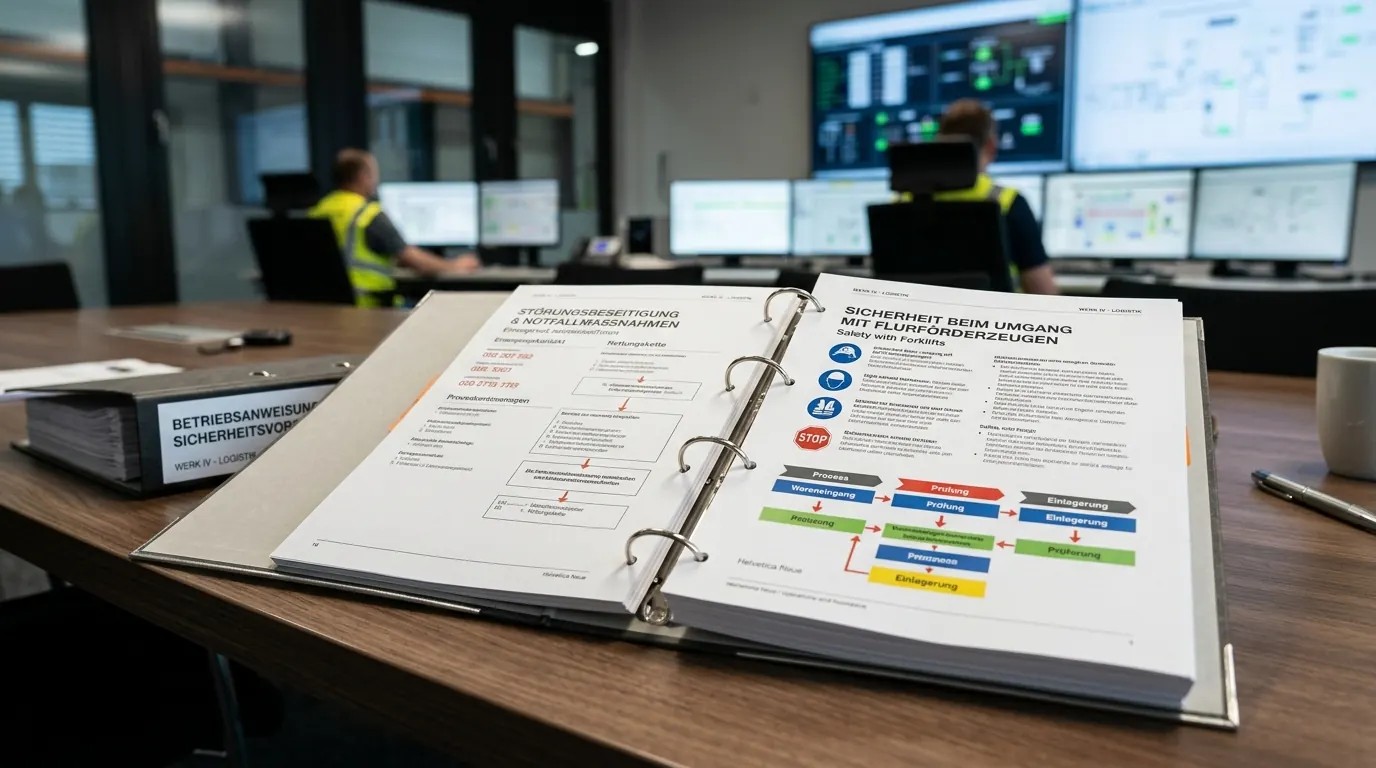
Which traps are hidden in telc Reading Part 3?
1. The Modal Verb Obligation Trap ("muss" vs. "sollte")
German regulatory prose differentiates strictly between legal obligations ("ist verpflichtet") and recommendations ("wird empfohlen"). Wrong options often swap these meanings.
2. The Generalization Trap ("grundsätzlich" vs. "ausnahmslos")
In German legal contexts, "grundsätzlich" implies that statutory exceptions exist. Confusing it with "always without exception" leads directly to trap answers.
3. Responsibility & Chain of Command
Pay meticulous attention to who is legally responsible: the employee individually, the safety officer, or the works council.
4. Chronological Sequences and Immediate Actions
Key terms like "unverzüglich" (without culpable delay), "prior to deployment", or "retrospectively" dictate the accurate choice.
Read these posts from a forum:
ONLINE-FORUM „RUND UM DEN BERUF“ – Thema: Regeln im Betrieb

a) Sandra, Personalabteilung:
„Bei uns ist die Nutzung privater Smartphones und Tablets für dienstliche Zwecke grundsätzlich untersagt. Ausnahmen bedürfen der vorherigen schriftlichen Genehmigung der IT-Leitung, und die VPN-Software ist vorher zu installieren.“

b) Tom, IT-Support:
„Wer einen Firmenlaptop oder ein Diensthandy verliert, muss das unverzüglich melden – dem direkten Vorgesetzten und der IT-Notfall-Hotline. Auf die nächste Teamsitzung zu warten, ist ausdrücklich nicht erlaubt.“

c) Ayse, Betriebsrätin:
„In unserer Betriebsvereinbarung steht: Nach spätestens 50 Minuten Bildschirmarbeit ist eine Pause von 10 Minuten einzulegen. Diese Pausen lassen sich nicht ansammeln, um früher Feierabend zu machen.“

d) Jens, Teamleiter:
„Mobiles Arbeiten ist bei uns an zwei Tagen pro Woche möglich, sofern die Teamleitung zustimmt. Einen Anspruch darauf gibt es aber nicht.“
Practice Items for Part 3 (Matching People and Posts)
Welcher Beitrag beantwortet die Frage der Person? Wählen Sie einen Beitrag oder „x“ (kein passender Beitrag) und prüfen Sie die Begründung:
Mira: "I would like to use my private tablet to read work emails. Am I simply allowed to do that?"
Paul: "My work phone was stolen on the train yesterday. Is it enough if I mention it at the team meeting on Friday?"
Lena: "I work shifts in production. Am I entitled to a bonus for night shifts?"
Which modal and passive patterns must you recognise in regulations?
Company agreements and compliance guidelines rely on rigorous administrative German. Master these four structural pillars:
Significance: Action is legally mandatory (= must be executed).
„Der Vorfall ist unverzüglich zu melden.“ (= The incident must be reported immediately).
Significance: Action is feasible or optional (= can be executed).
„Die Frist lässt sich verlängern.“ (= The deadline can be prolonged in exceptional cases).
Significance: The subject is formally ordered to act.
„Der Arbeitnehmer hat Schutzkleidung zu tragen.“ (= The worker is obligated to wear gear).
Significance: An official authorization is unconditionally required.
„Bedarf der vorherigen Genehmigung.“ (= Requires prior written permission).
Key Signal Words and Their Typical Paraphrases in Questions and Posts
Interaktiver Schnelltest: Regelsprache & Paraphrasen (4 Fragen)
Überprüfen Sie Ihre Präzision bei rechtlichen Formulierungen in telc B2 Lesen Teil 3:
1. What is the precise legal meaning of the keyword "grundsätzlich" in German company agreements?
2. How does the telc B2 exam differentiate between "müssen" (must) and "sollten" (should) in guidelines?
3. What is the precise meaning of the bureaucratic passive substitute "ist zu + Infinitive" in guidelines?
4. What is the most effective defense against distractors that copy text keywords verbatim?
Frequently asked questions
Why is Reading Part 3 often difficult?
Several posts talk about the same topic, but only one answers exactly a person's question, and for one person no post fits at all. In addition, posts often quote formal rules with passive voice and a nominal style, whose meaning hinges on a nuance such as "muss" versus "sollte".
What reading tactic saves the most time in Part 3?
Read the person's question first and sum up in one sentence what they want to know. Then look for the post that answers exactly this question; if none does, mark "x".
How many points do you need to pass?
Part 3 counts towards reading (60 points); the language elements (Sprachbausteine) count towards writing. You pass with at least 144 of 240 points in total and at least 36 of 60 in at least three of the four skills; one weaker skill is compensated if it has 24–35 points.
How should you tackle long compound nouns in the posts?
Break long words such as "Datenschutzgrundverordnungsrichtlinie" down from right to left. The base noun on the far right carries the main meaning; the parts in front narrow down the scope.
Can you underline and take notes in the question booklet?
Yes, you may underline passages, signal words and line numbers in the question booklet. Only what you transfer neatly to the answer sheet is scored.
How much time do you have for Reading Part 3?
Reading Parts 1–4 take 45 minutes together; there is no separate time limit for Part 3. Plan about 10 minutes for the 4 matches and check every answer against the text instead of getting stuck on single unknown words.
Related B2/C1 Study Guides & Exam Modules
Deepen your German proficiency with our focused preparation guides for telc B2.
Noun-Verb Combinations in Business
Light verb collocations for telc B2 and workplace communication with exam tips.
telc B2 Beruf Part 1A: Talking About a Topic
About 2 minutes on a topic, no preparation time: a 5-phase plan and 4 model talks.
Business Letters & Emails (DIN 5008)
Phrases for subject, deadlines and sign-off plus ready-to-use email templates.
Prepositions with Genitive in Business
Mastering aufgrund, während, trotz correctly while avoiding common dative traps.
Sicher durch Lesen Teil 3
Trainieren Sie alle 4 Leseteile mit prüfungsnahen Texten und sofortigen Erklärungen.
Jetzt Leseverstehen Teil 3 trainieren