telc B2 Beruf (DTB B2) • Speaking Part 1 Masterclass 2026

telc B2 Beruf: Talking about a Topic (Part 1A)
The 5-Step Plan, Phrases & 4 Model Talks

Updated: ·

Checked against the official DTB B2 practice tests (telc)•14 min read

In Part 1A of the oral exam you have about 2 minutes to talk freely about a topic – there is no preparation time. Our 5-phase structure, a framework in your head and 4 model talks help you prepare well.
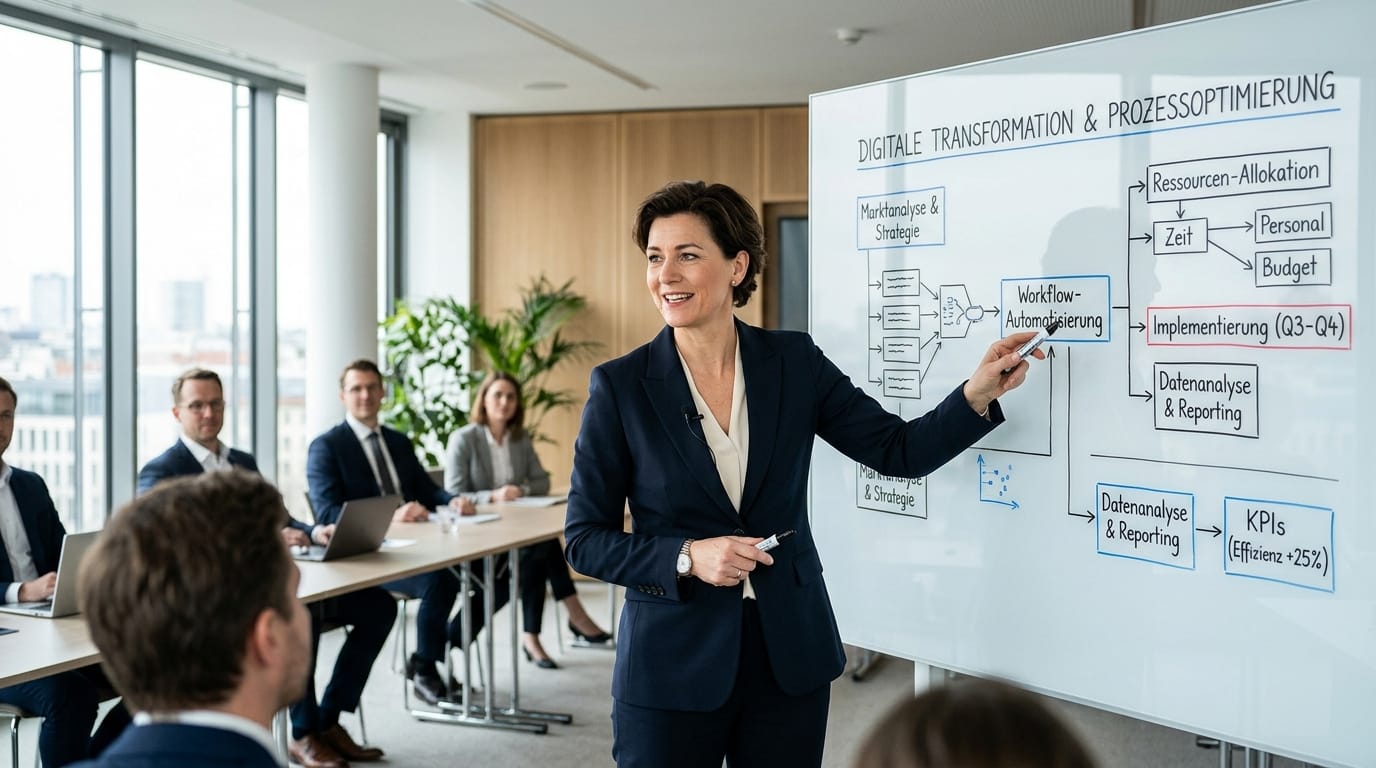
telc B2 Beruf Teil 1A: frei über ein Thema sprechen
1

1. How do you split the 2 minutes in Part 1A?

Planning the roughly 2 minutes clearly prevents blackouts and timing problems. Afterwards come the examiners’ questions (1B) and the short Part 1C. Here is a proven roadmap for your talk:

1

Phase 1: Intro & Relevance

Name topic formally, state personal reason for choosing it, announce outline (approx. 40 words).

0:00 - 0:25 Min.
2

Phase 2: Personal Workplace Experience

Relate concrete workplace case (home country or Germany), linking directly to your profession (approx. 50 words).

0:25 - 0:50 Min.
3

Phase 3: Balanced Arguments (Pros & Cons)

Contrast two major advantages and one crucial downside using B2 connectors (approx. 75 words).

0:50 - 1:25 Min.
4

Phase 4: Personal Conclusion & Outlook

Synthesize personal verdict clearly, provide forward outlook on sector trends (approx. 45 words).

1:25 - 1:50 Min.
5

Phase 5: Conclusion & Lead into Questions (1B)

Thank listeners for their attention and signal that you are ready for the examiners’ questions (approx. 15 words).

1:50 - 2:00 Min.
2

2. What should you have in your head when there is no preparation time?

There is no preparation time in the exam – you start talking right after choosing the topic. So build a framework in your head while practising, made of these three building blocks:

Baustein 1

Signalwörter & Ablauf

  • Einleitung (Thema)
  • Eigene Erfahrung (Praxis)
  • Vorteile vs. Nachteile
  • Fazit & Empfehlung
  • Fragen der Prüfenden (1B)
Baustein 2

Fachwörter & NVV

  • zur Verfügung stehen
  • in Kauf nehmen
  • Maßnahmen ergreifen
  • in Erwägung ziehen
  • Beitrag leisten
Baustein 3

Konnektoren (B2)

  • demgegenüber
  • einerseits ... andererseits
  • infolgedessen
  • zusammenfassend
  • meines Erachtens
3

3. Four Complete Model Talks with Examiners’ Questions

Learn suitable wording, connectors and convincing answers to questions in Part 1B across four realistic topics. Each talk can be spoken in about 2 minutes.

Topic 1: Remote Work & Home Office

Remote Work from Home - Curse or Blessing for Modern Working Life?

German model talk (approx. 2 min):
Sehr geehrte Prüferinnen und Prüfer, lieber Prüfungspartner, mein heutiges Thema lautet „Mobiles Arbeiten im Homeoffice - Fluch oder Segen für den modernen Berufsalltag?“. Ich habe dieses Thema gewählt, da die Digitalisierung unsere Arbeitswelt grundlegend verändert hat und viele von uns täglich vor der Herausforderung stehen, Berufs- und Privatleben in Einklang zu bringen. Ich möchte auf drei Punkte eingehen: Zunächst möchte ich von meinen persönlichen Erfahrungen berichten. Danach werde ich die wesentlichen Vor- und Nachteile gegenüberstellen, bevor ich mit einem kurzen Ausblick und meinem persönlichen Fazit abschließe. Was meine eigenen Erfahrungen betrifft, so arbeite ich seit zwei Jahren in einem hybriden Modell. Einerseits schätze ich die enorme Zeitersparnis, da der tägliche Berufsverkehr entfällt. Andererseits verlangt diese Arbeitsform ein hohes Maß an Selbstdisziplin, um eine klare Grenze zwischen Arbeitszeit und Erholungsphase zu ziehen. Kommen wir nun zu den Argumenten: Ein entscheidender Vorteil des Homeoffice liegt in der gesteigerten Konzentration bei komplexen Aufgaben, da Unterbrechungen durch Kollegen im Großraumbüro wegfallen. Demgegenüber muss jedoch der Verlust des spontanen kollegialen Austauschs genannt werden. Viele Innovationsprozesse entstehen informell an der Kaffeemaschine, was digital nur schwer kompensiert werden kann. Zusammenfassend bin ich der festen Überzeugung, dass ein hybrides Arbeitszeitmodell mit zwei bis drei Präsenztagen den idealen Kompromiss darstellt. Ich bedanke mich herzlich für Ihre Aufmerksamkeit und freue mich auf Ihre Fragen.
Complete English Translation for Fluency & Syntax Training:
Distinguished examiners, dear exam partner, My topic today is "Remote Work from Home - Curse or Blessing for Modern Working Life?". I selected this topic because digitalization has fundamentally transformed the workplace, and many of us face the daily challenge of harmonizing career commitments and personal life. I would like to address three points: First, I would like to report on my personal experiences. Next, I will compare the key advantages and disadvantages, before concluding with a forward outlook and my personal verdict. Regarding my own experiences, I have been working in a hybrid model for two years. On the one hand, I greatly value the massive time savings resulting from eliminating the daily commute. On the other hand, this working arrangement demands rigorous self-discipline to maintain a clear boundary between working hours and leisure. Turning now to the arguments: A decisive advantage of working from home is enhanced focus on complex tasks, as interruptions by open-plan office colleagues are eliminated. Conversely, the loss of spontaneous team interactions must be acknowledged. Innovative ideas often spark informally by the coffee machine, which is difficult to replicate digitally. In conclusion, I firmly believe that a hybrid model featuring two to three in-office days represents the ideal operational compromise. Thank you very much for your attention, and I look forward to your questions.

Typical Examiner Question (Part 1B) & Model Answer:

Frage der Prüfenden:

„Welche konkreten Maßnahmen empfehlen Sie Führungskräften, um den Teamgeist bei reiner Remote-Arbeit aufrechtzuerhalten?“

↳ What specific measures do you recommend to managers to maintain team cohesion in fully remote settings?

Muster-Antwort des Kandidaten:

„Führungskräfte sollten feste virtuelle Kaffeepausen und wöchentliche persönliche Check-ins etablieren sowie mindestens einmal pro Quartal gemeinsame Präsenztage im Betrieb veranstalten.“

↳ Managers should establish fixed virtual coffee chats and weekly personal check-ins, alongside organizing in-person company team days at least once per quarter.

Topic 2: Lifelong Learning & AI

Lifelong Learning and Professional Training in the Age of Artificial Intelligence

German model talk (approx. 2 min):
Guten Tag meine Damen und Herren, hallo [Name des Partners], ich spreche heute über das zukunftsweisende Thema „Lebenslanges Lernen und Weiterbildung im Zeitalter der Künstlichen Intelligenz“. Der Grund für mein großes Interesse an dieser Thematik ist offensichtlich: Durch generative Sprachmodelle und Automatisierungstools wandeln sich Berufsprofile heutzutage rasanter als je zuvor. Ich gehe auf drei Kernpunkte ein: Zunächst schildere ich meine eigene berufliche Praxis mit neuen Softwarelösungen. Anschließend beleuchte ich die Vorzüge und Hürden kontinuierlicher Weiterbildung. Zum Schluss fasse ich meine Kernaussage in einem Ausblick zusammen. Aus persönlicher Sicht erlebe ich beinahe wöchentlich, wie KI-Tools zeitraubende Routinearbeiten wie Datenanalysen oder Standard-E-Mails beschleunigen. Allerdings erfordert dieser Wandel von Fachkräften eine permanente Lernbereitschaft. Wer sich technischen Neuerungen verschließt, läuft Gefahr, den beruflichen Anschluss zu verlieren. Auf der Pro-Seite steht fest: Gezielte Weiterbildung eröffnet hervorragende Aufstiegschancen und sichert die Beschäftigungsfähigkeit langfristig ab. Als wesentlichen Nachteil empfinden viele Beschäftigte jedoch die zeitliche und finanzielle Belastung neben einer Vollzeitbeschäftigung. Mein Fazit lautet daher: Arbeitgeber sollten bezahlten Bildungsurlaub und interne Weiterbildungsbudgets nicht als Kostenfaktor, sondern als strategische Zukunftsinvestition begreifen. Vielen Dank für Ihre Aufmerksamkeit. Ich stehe nun gerne für Ihre Rückfragen zur Verfügung.
Complete English Translation for Fluency & Syntax Training:
Good day ladies and gentlemen, hello [Partner's Name], Today I am talking about the forward-looking topic "Lifelong Learning and Professional Training in the Age of Artificial Intelligence". The reason for my deep interest in this topic is evident: driven by generative AI models and workflow automation tools, job descriptions are transforming faster today than ever before. I will address three key points: First, I will share my own workplace experiences with emerging software solutions. Next, I will evaluate the benefits and hurdles of continuous upskilling. Finally, I will synthesize my core conclusion in an outlook. From a personal perspective, I experience almost weekly how AI applications accelerate time-consuming routine tasks such as data parsing or drafting standard emails. However, this transformation demands ongoing adaptability from specialists. Those who resist technological innovations risk losing professional competitiveness. On the positive side: targeted continuing education unlocks remarkable career advancement prospects and safeguards long-term employability. Conversely, many professionals view the investment of time and personal finances alongside full-time jobs as a heavy strain. My conclusion is therefore: Employers must view paid educational leaves and internal training budgets not as overhead costs, but as vital strategic investments in their corporate future. Thank you very much for your attention. I am now delighted to answer your questions.

Typical Examiner Question (Part 1B) & Model Answer:

Frage der Prüfenden:

„Wer sollte Ihrer Meinung nach die Kosten für solche KI-Schulungen primär tragen - der Arbeitgeber oder der Arbeitnehmer?“

↳ In your opinion, who should primarily bear the costs of such AI training courses - the employer or the employee?

Muster-Antwort des Kandidaten:

„Da Unternehmen unmittelbar von höherer Effizienz und Fehlerreduktion profitieren, sollte der Arbeitgeber mindestens siebzig Prozent der Schulungskosten und die notwendige Arbeitszeit übernehmen.“

↳ Since enterprises profit directly from increased operational efficiency and fewer errors, employers should cover at least seventy percent of training costs and work hours.

Topic 3: Work Models & Skills Shortages

The Four-Day Workweek as a Solution to Skills Shortages and Burnout

German model talk (approx. 2 min):
Guten Tag allerseits, heute möchte ich über ein Arbeitszeitmodell sprechen, das gegenwärtig intensive Debatten in der Wirtschaft auslöst: Die Einführung der Vier-Tage-Woche bei vollem Lohnausgleich. Angesichts des akuten Fachkräftemangels in Deutschland stehen Betriebe vor der Notwendigkeit, ihre Attraktivität als Arbeitgeber drastisch zu steigern, um junge Talente langfristig zu binden. Ich gehe dabei in drei Schritten vor: Zunächst schildere ich Beobachtungen aus meinem bisherigen Berufsalltag. Im Anschluss diskutiere ich die wesentlichen Pro- und Contra-Argumente. Abschließend präsentiere ich mein persönliches Fazit. In meiner bisherigen Tätigkeit im Kundenservice habe ich häufig erlebt, wie chronische Überstunden zu krankheitsbedingten Ausfällen und Demotivation führten. Ein zusätzlicher freier Tag pro Woche könnte die Regenerationszeit signifikant verlängern. Befürworter betonen zu Recht, dass Pilotprojekte in mehreren europäischen Ländern eine gesteigerte Produktivität pro Arbeitsstunde sowie einen Rückgang von Krankheitstagen um bis zu dreißig Prozent nachweisen. Kritiker wenden demgegenüber ein, dass Branchen mit Schichtbetrieb - wie die Logistik oder die Pflege - diesen Ausfall personell kaum kompensieren können. Mein Resümee lautet: Die Vier-Tage-Woche ist kein Allheilmittel für jede Branche, aber ein hochwirksames Instrument für wissensbasierte Berufe und moderne Dienstleister. Ich danke Ihnen für Ihre Aufmerksamkeit und freue mich auf Ihre Anmerkungen.
Complete English Translation for Fluency & Syntax Training:
Good day everyone, Today I would like to talk about a working hours framework that currently sparks intense debate across industries: introducing the four-day workweek with 100% wage compensation. In light of acute skilled labor shortages across Germany, companies face the urgent necessity to boost employer branding to retain talented professionals long-term. I will proceed in three steps: First, I will share observations from my professional career to date. Next, I will discuss the central pro and con arguments. Finally, I will present my personal conclusion. In my prior role in customer operations, I frequently observed how chronic overtime led to sick leave and burnout. An extra day off each week could substantially prolong mental regeneration. Proponents rightfully highlight that international pilot trials demonstrate higher hourly productivity and up to thirty percent fewer sick days. Conversely, critics argue that shift-based sectors - such as logistics and healthcare - can barely compensate for lost shifts given staffing shortages. My takeaway is: the four-day week is not a one-size-fits-all solution for every sector, but an immensely powerful lever for knowledge workers and modern service firms. Thank you for your attention, and I welcome your feedback.

Typical Examiner Question (Part 1B) & Model Answer:

Frage der Prüfenden:

„Lässt sich eine Vier-Tage-Woche auch in personalintensiven Branchen wie der Pflege oder im Handwerk realistisch umsetzen?“

↳ Can a four-day week be realistically implemented in labor-intensive fields such as nursing or trade crafts?

Muster-Antwort des Kandidaten:

„In diesen personalintensiven Branchen ist eine pauschale Reduzierung schwierig. Denkbar wären jedoch flexible Arbeitszeitkonten und gestaffelte Schichtmodelle, um Burnout vorzubeugen.“

↳ In staffing-intensive sectors, an across-the-board reduction is challenging. However, flexible working time accounts and staggered shift arrangements could alleviate burnout.

Topic 4: Corporate Sustainability

Sustainability and Resource Efficiency as Competitive Advantages for SMEs

German model talk (approx. 2 min):
Sehr geehrte Prüferinnen und Prüfer, hallo Kollege, heute möchte ich mich mit dem Thema „Nachhaltigkeit und Ressourceneffizienz im Betrieb - Marketingtrend oder echter Wettbewerbsvorteil?“ befassen. Ich habe dieses Thema gewählt, weil ökologisches Wirtschaften und gesetzliche ESG-Vorgaben für Unternehmen aller Branchen existenzentscheidend geworden sind. Ich gehe dabei so vor: Zuerst berichte ich über eigene Erfahrungen mit Energiesparmaßnahmen in unserem Betrieb. Danach wiege ich die wirtschaftlichen Chancen und Kosten ab, bevor ich ein persönliches Fazit ziehe. In unserem Unternehmen haben wir vor einem Jahr ein internes Energieaudit durchgeführt. Durch die Umstellung auf intelligente LED-Beleuchtung und die Vermeidung von Einwegplastik in der Kantine konnten wir die Betriebskosten spürbar senken. Auf der Pro-Seite steht fest: Nachhaltige Betriebe genießen ein deutlich besseres Image bei umweltbewussten Kunden und haben messbare Vorteile bei Ausschreibungen öffentlicher Auftraggeber. Allerdings erfordern tiefgreifende Maßnahmen - wie die Anschaffung von Photovoltaikanlagen oder Elektro-Lieferwagen - beträchtliche Vorabinvestitionen, die kleinere Betriebe belasten. Zusammenfassend lässt sich sagen: Ressourcenschonung ist kein kurzfristiger Trend, sondern eine unabdingbare Notwendigkeit für die Zukunftsfähigkeit mittelständischer Unternehmen. Ich danke Ihnen für Ihre Aufmerksamkeit und freue mich auf Ihre Fragen.
Complete English Translation for Fluency & Syntax Training:
Distinguished examiners, hello colleague, Today I would like to address the topic "Sustainability and Resource Efficiency in the Workplace - Marketing Hype or Genuine Competitive Edge?". I selected this topic because green operations and regulatory ESG compliance frameworks have become existential priorities for enterprises across all sectors. I will proceed as follows: First, I will share personal experiences regarding energy-saving measures in our firm. Next, I will balance the economic opportunities against upfront expenditures, before drawing my conclusion. At our workplace, we conducted an internal energy audit one year ago. By transitioning to smart LED lighting and eliminating single-use plastics in the cafeteria, we noticeably curtailed running overhead costs. On the positive side: sustainable enterprises enjoy a substantially stronger brand image among eco-conscious clients and gain tangible advantages during public procurement tenders. Conversely, deep structural investments - such as commercial solar panels or electric delivery fleets - entail substantial capital expenditures that burden smaller companies. In conclusion: conserving resources is not a short-lived trend, but an indispensable imperative for the future viability of medium-sized companies. Thank you very much for your attention, and I look forward to your questions.

Typical Examiner Question (Part 1B) & Model Answer:

Frage der Prüfenden:

„Welche Hürden sehen Sie bei der Umstellung auf nachhaltige Prozesse in kleineren Handwerksbetrieben?“

↳ What hurdles do you observe when transitioning to sustainable operations in smaller craft businesses?

Muster-Antwort des Kandidaten:

„Die größte Hürde stellen die hohen Anschaffungskosten für emissionsarme Maschinen und der Mangel an Fachwissen für bürokratische Förderanträge dar.“

↳ The biggest hurdle is high initial capital expenditures for low-emission machinery, alongside lack of administrative expertise for government subsidy applications.

4

4. Systematic Phrase Catalog for all 5 Phases of Your Talk

Filter by phase to learn the phrases you can recall instantly without preparation.

Names topic precisely while instantly conveying professional relevance.

„Ich spreche heute über das Thema [...], das eine zentrale Frage unserer Arbeitswelt berührt.“

↳ Today I am talking about the topic [...], which touches upon a central question of our working world.

Explains why you chose the topic – a personal opening.

„Ich habe mich ganz bewusst für dieses Thema entschieden, da es in den Medien und Betrieben kontrovers diskutiert wird.“

↳ I deliberately chose this topic because it is being controversially debated across media and enterprises.

Signals clear rhetorical roadmap to examiners (0:00 - 0:25 min).

„Ich möchte auf drei Punkte eingehen: Zunächst [...], danach [...] und abschließend [...].“

↳ I would like to address three points: first [...], next [...], and finally [...].

Smooth transition utilizing subordinate clause syntax (bevor).

„Um Ihnen einen strukturierten Überblick zu geben, möchte ich zuerst auf meine Erfahrungen eingehen, bevor ich Pro und Contra abwäge.“

↳ To give you a structured overview, I would like to address my own experiences first, before weighing the pros and cons.

Opens the personal experience section (0:25 - 0:50 min).

„Aus meiner persönlichen beruflichen Praxis heraus kann ich berichten, dass [...].“

↳ Based on my personal professional experience, I can report that [...].

Two-part connector (sowohl ... als auch) demonstrates authentic B2 mastery.

„In meinem Heimatland sowie während meiner Tätigkeit in Deutschland habe ich festgestellt, dass [...].“

↳ Both in my home country and during my work in Germany, I observed that [...].

Sophisticated comparison using formal adverb (demgegenüber).

„Ein ausschlaggebender Vorteil besteht darin, dass [...]. Demgegenüber muss jedoch betont werden, dass [...].“

↳ A decisive advantage lies in the fact that [...]. In contrast, however, it must be stressed that [...].

Einerseits/andererseits is standard B2 repertoire.

„Einerseits ermöglicht diese Lösung eine erhebliche Effizienzsteigerung, andererseits entstehen anfänglich beträchtliche Kosten.“

↳ On the one hand, this solution enables substantial efficiency gains; on the other hand, considerable upfront costs arise.

Passive substitute form (lässt sich festhalten) shows your range of language.

„Zusammenfassend lässt sich festhalten, dass [...]. Meines Erachtens überwiegen die Vorzüge eindeutig.“

↳ In summary, it can be stated that [...]. In my judgment, the benefits clearly outweigh the downsides.

Clearly marks the end and leads into the examiners’ questions (1B).

„Damit bin ich am Ende meines Beitrags angelangt. Ich bedanke mich für Ihre Aufmerksamkeit und freue mich auf Ihre Fragen.“

↳ With that, I have reached the end of my talk. Thank you for your attention, and I look forward to your questions.

5

5. Interactive Tactical Quiz: Are You Ready for Part 1?

Evaluate your behavioral and conversational instincts across 5 typical exam-room situations.

1

How long should your talk in Part 1A ideally last?

2

What happens right after your talk in Part 1A?

3

How do you prepare for Part 1A when there is no preparation time in the exam?

4

Why is it worth including a personal experience in your talk?

5

How do you handle an examiner question in Part 1B that you did not hear properly?

6. Frequently Asked Questions (FAQ)

Can I choose any topic for Part 1A?

No. In the exam you are given two topics and choose one of them; there is no preparation time. The official practice test publishes eight possible topics – so practise with as many work topics as possible.

What happens if my talk is much shorter than 2 minutes?

Part 1A allows about 2 minutes per person. Speaking much less shows less of what you can do. So keep one or two extra examples in reserve that you can add if needed.

Who asks the questions after my talk – the examiners or my partner?

In Part 1B the examiners ask the questions (approx. 2 minutes). Your partner comes in at Part 1C: in approx. ½ minute they explain one aspect of your talk – and you do the same for theirs. That is why both of you should listen carefully.

Should you memorise a talk word for word?

Strongly discouraged! You choose the topic only in the exam, and memorised texts sound monotonous and unnatural. The moment nerves make you forget a single word, the flow collapses. Learn the flexible 5-step structure and fixed phrases instead.

How many points does Part 1 bring, and when is the exam passed?

For task completion, Part 1A gives up to 5, 1B up to 5 and 1C up to 2 points; on top of that comes the language assessment of the whole oral exam. Speaking is worth up to 60 of 240 points in total. You pass with at least 144 of 240 points in total and at least 36 of 60 in at least three of the four skills; one weaker skill is compensated if it has 24–35 points.

What language register is expected in Part 1A?

Elevated standard workplace German is expected. Eliminate colloquial fillers ("also", "irgendwie", "halt"). Instead, use precise professional terms, noun-verb collocations and logical connectors such as "demgegenüber", "infolgedessen" and "zusammenfassend".

LexDeutsch Ratgeber

Related B2/C1 Study Guides & Exam Modules

Deepen your German proficiency with our focused preparation guides for telc B2.

Part 1 Speaking Training & Stopclock

Practise Your Talk with the Interactive Timer

Time your 2 minutes with a stopwatch, practise answering spontaneous examiner questions, and go into Part 1 with confidence.