telc B2 Listening Part 1: Global Comprehension, Single Playback & Audio Traps
Updated: · LexDeutsch editorial team
3 conversations, 6 items, zero replays: read the items in advance, detect mid-sentence changes of plan, and avoid typical mistakes.
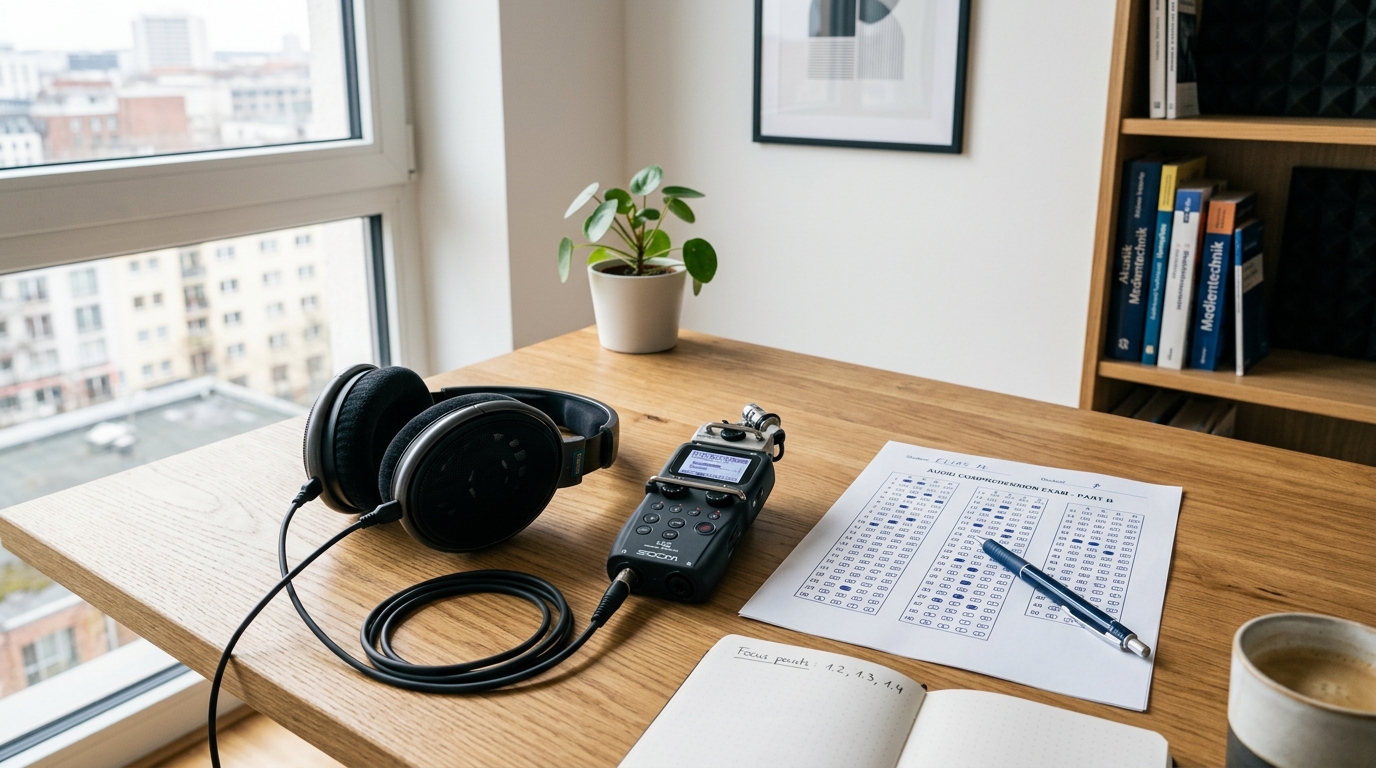
Underline Keywords and Negations in Task Prompts
In Part 1 you hear three conversations from everyday work (work processes, problems, suggestions). Each conversation has one statement (true or false) and one question with a, b or c – 6 items in total. Read both items before the conversation starts and underline the core statement along with qualifying words (nur, fast, alle, nicht, ausschließlich, bereits).
Chronological Tracking: You Hear the Audio ONCE
In telc B2 Listening Part 1, the track is played strictly once. The answers follow the chronological flow of the speaker. If you miss one question, instantly let it go and anchor onto the next prompt.
The Final Clause Decides: Speakers Often Correct Themselves
A typical pattern in listening texts: the speaker first introduces option A positively, only to revise it seconds later ("we initially planned Tuesday... however due to the trade fair we definitely moved it to Thursday"). Marking too early costs points.
Related B2/C1 Study Guides & Exam Modules
Deepen your German proficiency with our focused preparation guides for telc B2.
Noun-Verb Combinations in Business
Light verb collocations for telc B2 and workplace communication with exam tips.
telc B2 Beruf Part 1A: Talking About a Topic
About 2 minutes on a topic, no preparation time: a 5-phase plan and 4 model talks.
Business Letters & Emails (DIN 5008)
Phrases for subject, deadlines and sign-off plus ready-to-use email templates.
Prepositions with Genitive in Business
Mastering aufgrund, während, trotz correctly while avoiding common dative traps.
Frequently asked questions
How long is the listening section of telc B2 Beruf?
The Listening subtest takes 20 minutes and has 4 parts: Part 1 three conversations about work processes, problems and suggestions (3 true/false + 3 multiple choice), Part 2 arguments (4 matching items), Part 3 a meeting or presentation (4 multiple choice) and Part 4 requests (5 multiple choice). It is followed by the short "Hören und Schreiben" part (5 minutes) with the phone note.
Can you pause the recording or have it replayed in the exam?
No. You hear each conversation only once; the recording plays centrally for all candidates, and parts are not replayed on request. If you miss an item, move straight on to the next one.
What should you do before the audio starts in Part 1?
Read all the items before the recording starts and underline the key statement of each one. Mark limiting signal words such as "nur", "nicht", "alle" or "bereits", because the answer often turns on exactly these words.
Why does the last statement in the recording often count?
Speakers often mention a plan first and then correct it, for example "Wir wollten das Meeting am Dienstag abhalten, verschieben es aber auf Donnerstag." Listen for signal words such as "aber", "jedoch" or "doch": the information after them is usually the one that counts.
Is the answer that uses the same words as the recording the right one?
Often not. The correct answer usually restates the content in other words, while wrong options copy words from the recording and twist the meaning. So always check the meaning, not the wording.
What should you do if you did not understand a word in the recording?
Do not get stuck on the word; follow the context, the stress and the verbs. The unknown word is often irrelevant to the answer or is explained in simpler words in the next sentence.
How many points do you need to pass telc B2 Beruf?
Listening is one of four skills worth 60 points each (240 in total). You pass with at least 144 of 240 points in total and at least 36 of 60 in at least three of the four skills; one weaker skill is compensated if it has 24–35 points.
Practise Listening Part 1 in the Exam Format
In the LexDeutsch listening trainer you practise with our own tasks in the exam format and see after checking whether your answer is right; for most tasks the line in the transcript that contains the answer is highlighted. The first three tasks are free without signing up.