telc B2 Beruf Speaking Exam
Structure, Scoring, Phrases & 4 Model Talks
Updated: · LexDeutsch editorial team
The oral exam often feels like the hardest part – especially since there is no preparation time. Prepare for Parts 1, 2 and 3 with a fixed structure, the assessment criteria, 4 model talks for Part 1A with follow-up questions and useful phrases.
1. How does the oral exam work?
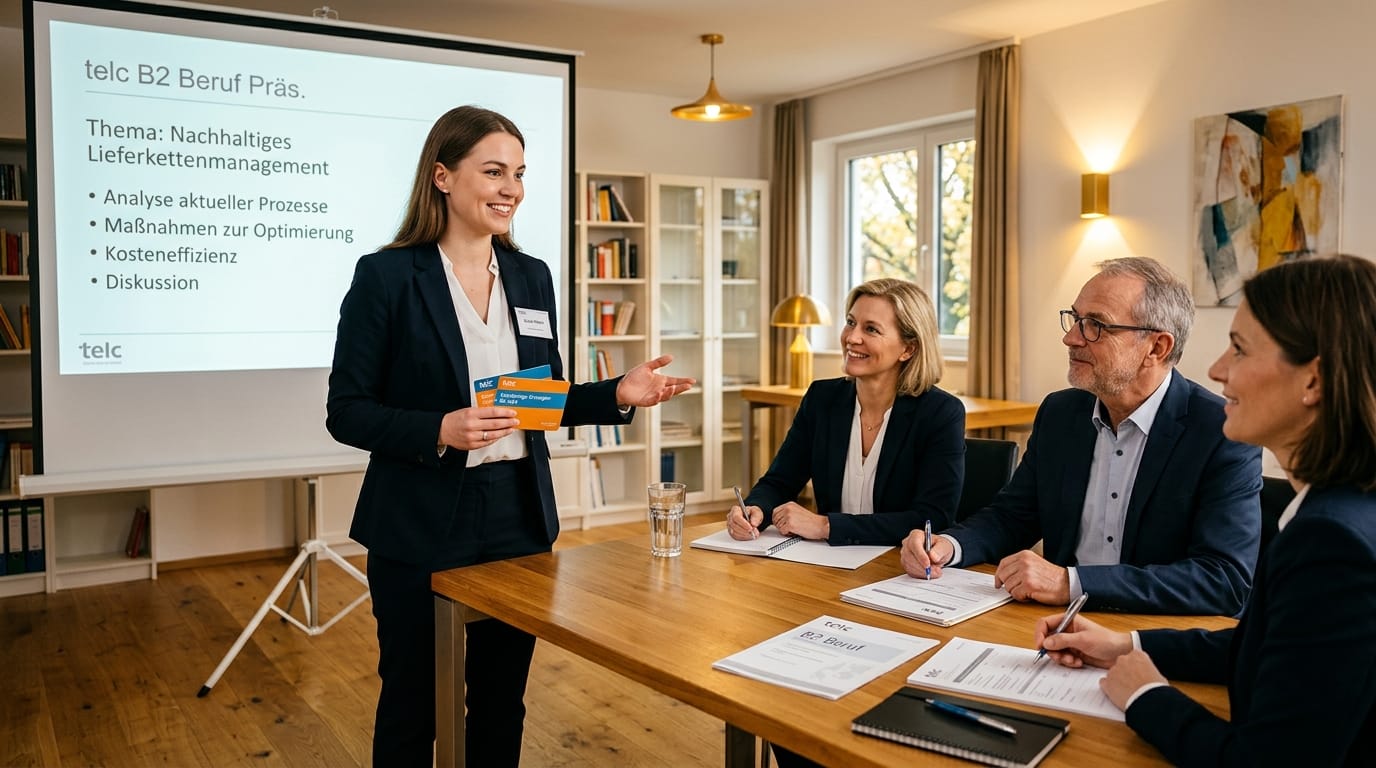
The oral exam is a paired exam of about 16 minutes with two licensed examiners: one leads the conversation, the other observes. There is no preparation time – you get the tasks directly in the exam.
Talking about a topic (1A–1C)
1A: talk freely about one of two topics (approx. 2 min per person, no preparation); 1B: approx. 2 min of examiners’ questions; 1C: explain one aspect of your partner’s talk in approx. ½ min.
Chat with Colleagues
Informal chat during a break, using "du" (e.g. about working hours, training, the team): tell, ask, react. No agreement is needed.
Discussing Solutions
Solve a workplace problem together: clarify what needs to be done and who takes on which task, plus long-term improvements – arrive together at a plan of who does what.
No Preparation Time: How to Prepare Beforehand
Practise beforehand: talking freely for 2 minutes on typical work topics (opening, two or three points with examples, a short ending), casual follow-up questions using "du" for Part 2 and, for Part 3, the three steps name the problem – weigh solutions – split the tasks. Learn phrases, not whole texts.
2. How is the oral exam scored?
Speaking is worth up to 60 of 240 points. You pass with at least 144 of 240 points in total and at least 36 of 60 in at least three of the four skills; one weaker skill is compensated if it has 24–35 points. Marking follows the four criteria of the DTB B2; under each criterion is our preparation tip:
| Criterion | Points |
|---|---|
| I Kommunikative Aufgabenbewältigung (completing the task) Our tip: Work through your outline in Part 1A, speak for about 2 minutes, and in Part 3 settle together who takes on which task. | maximum per part:
|
| II Kommunikative Gestaltung (shaping the conversation) Our tip: Speak freely instead of reading out, respond to your partner’s objections, ask follow-up questions. | II–IV together up to 30 |
| III Formale Richtigkeit (accuracy) Our tip: Get word order in subordinate clauses and verb forms right; speak clearly. | |
| IV Spektrum sprachlicher Mittel (range of language) Our tip: Workplace terms, noun-verb collocations and connectors instead of simple everyday words. | |
| Speaking in total: up to 60 of 240 points | |
Source: assessment criteria and points in the official DTB B2 practice test (telc, published by BAMF).
3. Part 1A Deep Dive: 4 Model Talks with Examiners’ Questions
In Part 1A you choose one of two topics and talk freely for about 2 minutes without preparation. In Part 1B the examiners ask questions for about 2 minutes, and in Part 1C your partner explains one aspect of your talk in about ½ minute.
From Career Shift to Logistics Specialist & Supply Chain Management
Typical Examiner Question (Part 1B) & Model Answer:
Frage der Prüfenden:
„Welche besonderen Herausforderungen sehen Sie bei der Einführung neuer ERP-Systeme in Ihrem Bereich?“
↳ What specific challenges do you see when introducing new ERP systems in your department?
Muster-Antwort des Kandidaten:
„Eine zentrale Herausforderung besteht darin, erfahrene Mitarbeiter für die neuen digitalen Masken zu schulen und Vorbehalte abzubauen. Durch praxisnahe Kurzschulungen und klare Prozessleitfäden lässt sich die Akzeptanz jedoch rasch sichern.“
↳ A key challenge is training experienced staff on the new digital interfaces and reducing skepticism. However, hands-on brief workshops and clear process guides quickly ensure acceptance.
Mobile Care Software "CareTime 360" for Outpatient Nursing Services
Typical Examiner Question (Part 1B) & Model Answer:
Frage der Prüfenden:
„Wie wird der Datenschutz bei der Übertragung solch sensibler Gesundheitsdaten technisch gewährleistet?“
↳ How is data privacy technically ensured during the transmission of such sensitive health records?
Muster-Antwort des Kandidaten:
„Die Datenübertragung erfolgt über eine TLS-1.3-Verschlüsselung zu ISO-27001-zertifizierten Rechenzentren in Frankfurt am Main. Lokal auf dem Smartphone werden keine Patientendaten dauerhaft gespeichert.“
↳ Transmission uses TLS 1.3 encryption to ISO 27001-certified data centers in Frankfurt am Main. No patient records are stored permanently on the local smartphone.
Transition to a Paperless Office via Digital Document Management (DMS)
Typical Examiner Question (Part 1B) & Model Answer:
Frage der Prüfenden:
„Wie hoch waren die anfänglichen Softwarekosten und wann rechnet sich diese Investition betriebswirtschaftlich?“
↳ How high were the upfront software costs and when will this capital investment break even financially?
Muster-Antwort des Kandidaten:
„Die Gesamtinvestition für Lizenzen und Serverinfrastruktur belief sich auf circa fünfundzwanzigtausend Euro. Durch eingesparte Archivierungs- und Personalsuchzeiten amortisiert sich das System bereits nach vierzehn Monaten.“
↳ Total expenditure for licenses and server infrastructure was around twenty-five thousand euros. Reduced archiving and file retrieval labor will break even after just fourteen months.
Process Optimization in Customer Service Following Delivery Delays
Typical Examiner Question (Part 1B) & Model Answer:
Frage der Prüfenden:
„Welche finanziellen Mehrkosten entstanden durch die kostenlosen Leihgeräte?“
↳ What additional financial expenditures were incurred by providing complimentary loan equipment?
Muster-Antwort des Kandidaten:
„Die Logistikkosten für die Leihgeräte lagen bei rund achttausend Euro. Verglichen mit den drohenden Stornierungen im Wert von über einhundertfünfzigtausend Euro war diese Maßnahme betriebswirtschaftlich hochgradig rentabel.“
↳ Logistics expenses for the loan equipment totaled roughly eight thousand euros. Compared to threatened cancellations worth over one hundred fifty thousand euros, this measure was remarkably cost-effective.
4. Systematic Formula Catalog for Parts 1, 2, 3 & Emergency Scenarios
Filter by exam part to practise the phrases you can recall instantly when there is no preparation time.
„Ich habe mich für das Thema [...] entschieden, weil es in meinem Arbeitsalltag eine große Rolle spielt.“
↳ I have chosen the topic [...] because it plays a big role in my everyday work.
„Ich möchte auf drei Punkte eingehen: Zunächst [...], danach [...] und abschließend [...].“
↳ I would like to address three points: first [...], then [...], and finally [...].
„Zusammenfassend lässt sich festhalten, dass diese Maßnahme maßgeblich zur Effizienzsteigerung beiträgt.“
↳ In summary, it can be stated that this measure significantly contributes to increased efficiency.
„Das wäre es von meiner Seite. Vielen Dank fürs Zuhören – ich beantworte gern Ihre Fragen.“
↳ That is all from my side. Thank you for listening – I am happy to answer your questions.
„Und wie läuft das bei dir in der Abteilung? Habt ihr auch so viele Überstunden?“
↳ And how is that going in your department? Do you also have so much overtime?
„Ach, echt? Das kenne ich. Bei uns war das letztes Jahr ganz ähnlich, aber dann haben wir die Schichten neu verteilt.“
↳ Oh, really? I know that. It was very similar for us last year, but then we redistributed the shifts.
„Aus meiner Erfahrung kann ich sagen: Mit flexiblen Arbeitszeiten bin ich viel motivierter. Wie siehst du das?“
↳ From my experience I can say: with flexible working hours I am much more motivated. What do you think?
„Was meinst du: Wie wirkt sich das langfristig auf die Stimmung im Team aus?“
↳ What do you think: how will this affect the mood in the team in the long run?
„Angesichts des knappen Zeitbudgets sollten wir uns vorrangig auf die kritischen Kernprozesse konzentrieren.“
↳ Given the tight timeframe, we should prioritize critical core processes.
„Wie wäre es, wenn wir die anfallenden Aufgaben aufteilen: Sie übernehmen die Lieferanten und ich die Kundenkommunikation?“
↳ How about dividing the upcoming tasks: you handle suppliers and I take over client communications?
„Halten wir also fest: Ich kümmere mich um den neuen Schichtplan, und Sie sprechen bis Ende der Woche mit der Teamleitung.“
↳ So let us sum up: I will take care of the new shift plan, and you will talk to the team leader by the end of the week.
„Da haben Sie einen wichtigen Punkt berührt. Könnten wir uns darauf einigen, einen externen Berater hinzuzuziehen?“
↳ You touched upon a crucial point there. Could we agree on bringing in an external consultant?
„Entschuldigung, jetzt habe ich kurz den Faden verloren. Was ich eigentlich verdeutlichen wollte, ist Folgendes: [...]“
↳ Excuse me, I momentarily lost my train of thought. What I actually wanted to highlight is the following: [...].
„Könnten Sie diesen Aspekt bitte noch einmal kurz erläutern? Ich bin mir nicht sicher, ob ich Sie akustisch richtig verstanden habe.“
↳ Could you please briefly clarify that point once more? I am not sure if I heard you correctly.
„Darf ich Sie an dieser Stelle kurz unterbrechen? Das ist ein spannender Gedanke, aber mich würde auch interessieren, wie wir [...]“
↳ May I briefly interrupt you at this point? That is an intriguing thought, but I would also be interested in how we [...].
„Wie beurteilen Sie diesen Vorschlag aus Ihrer fachlichen Perspektive, Herr/Frau [Name]?“
↳ How do you assess this proposal from your professional perspective, Mr./Ms. [Name]?
5. Interactive Tactical Quiz: Real Exam Room Scenarios
Evaluate your behavioral and conversational instincts across 5 typical speaking scenarios.
What is the best way to end your talk in Part 1A?
In Part 3, your partner talks non-stop and barely gives you space. What should you do?
In the middle of your talk in Part 1A you forget a technical term and stumble. What is the best strategy?
Is it worth memorising a finished text for Part 1A?
What is the main goal of Part 3 (discussing solutions)?
6. Frequently Asked Questions (FAQ)
Is there preparation time before the oral exam?
No. In telc B2 Beruf (DTB B2) there is no preparation time: in Part 1A you choose one of two topics and talk about it straight away. So prepare beforehand by practising free speaking and learning phrases for opening, asking back and splitting tasks.
What happens if your exam partner is exceptionally weak or overpowering?
Examiners assess each candidate individually. If your partner goes quiet, draw them in with open questions ("Wie siehst du das?" in Part 2, "Wie beurteilen Sie diesen Aspekt?" in Part 3). If your partner dominates, interrupt politely but firmly using the phrases you have learned.
How many points is the oral exam worth and when is the exam passed?
Speaking is worth up to 60 of 240 points. You pass with at least 144 of 240 points in total and at least 36 of 60 in at least three of the four skills; one weaker skill is compensated if it has 24–35 points.
What happens if I am weak in speaking but do well in the written exam?
It depends on the points: if Speaking has 24–35 points, it is compensated as long as the total is at least 144 and Reading, Listening and Writing have at least 36 each. Below 24 points in Speaking the exam is failed. Your test centre can tell you how to retake it.
How long does each part of the oral exam last?
About 16 minutes in pairs in total: Part 1A approx. 2 minutes per person (talking about a topic), Part 1B approx. 2 minutes of examiners’ questions, Part 1C approx. ½ minute (explaining one aspect of your partner’s talk), Part 2 approx. 3 minutes of chat with colleagues and Part 3 approx. 4 minutes discussing solutions.
Do we have to reach a joint solution in Part 3?
The goal of Part 3 is a joint plan: together you clarify what needs to be done and who takes on which task, and talk about long-term improvements. So arrive together at a plan of who does what instead of just defending your own position. In Part 2, the informal chat with colleagues, no agreement is needed.
Related B2/C1 Study Guides & Exam Modules
Deepen your German proficiency with our focused preparation guides for telc B2.
Noun-Verb Combinations in Business
Light verb collocations for telc B2 and workplace communication with exam tips.
telc B2 Beruf Part 1A: Talking About a Topic
About 2 minutes on a topic, no preparation time: a 5-phase plan and 4 model talks.
Business Letters & Emails (DIN 5008)
Phrases for subject, deadlines and sign-off plus ready-to-use email templates.
Prepositions with Genitive in Business
Mastering aufgrund, während, trotz correctly while avoiding common dative traps.
Practise the Speaking Exam Out Loud
In the LexDeutsch speaking trainer you record your answers and listen back, practise with sample dialogues with audio and consolidate your professional B2 vocabulary. The first three topics are free; the rest are part of VIP.