telc B2 Business Language Elements & Business Letters 2026: A Practical Guide
Updated: · LexDeutsch editorial team
Sprachbausteine Parts 1 & 2, the reply to a complaint under DIN 5008, noun-verb collocations and distractor tactics – a compact guide for telc B2 Beruf (DTB B2).
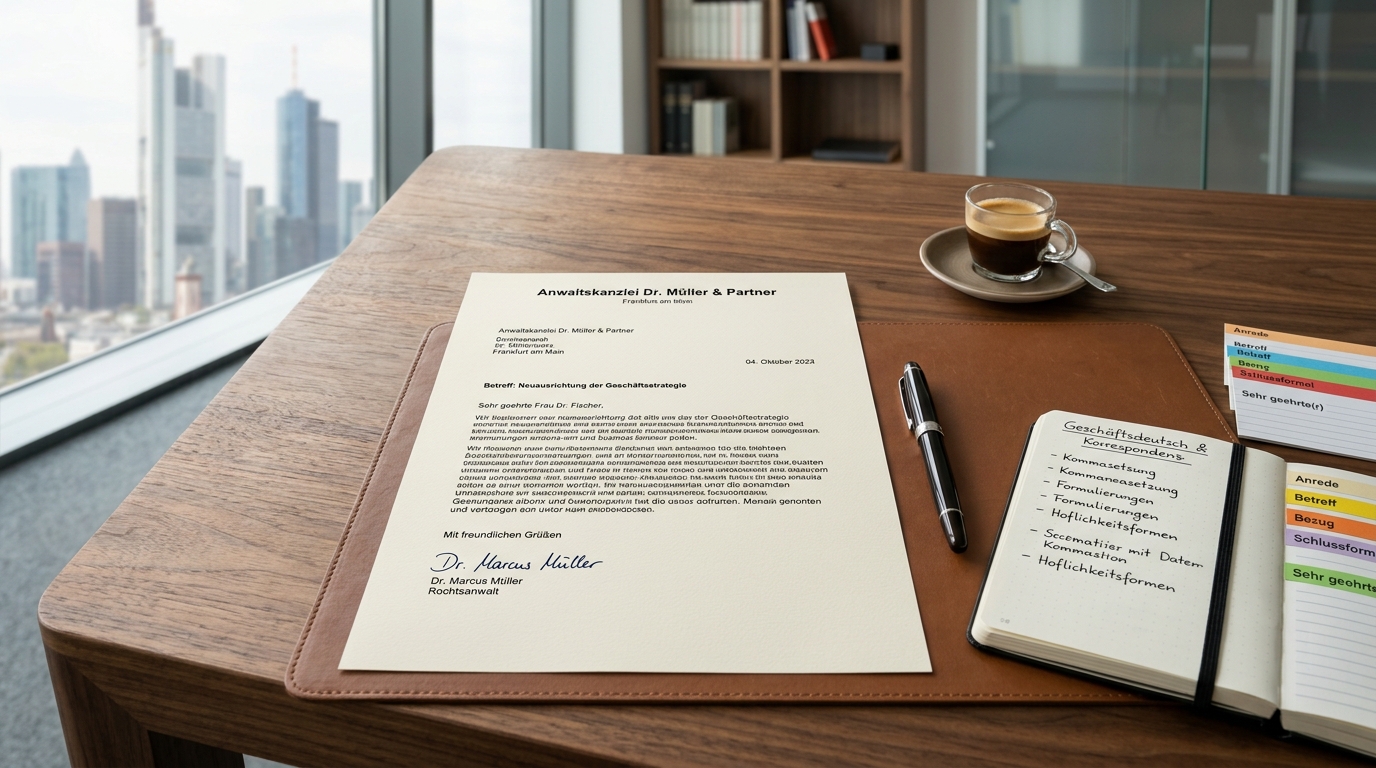
Why do Sprachbausteine and business letters decide whether you pass?
In telc B2 Beruf – officially the DTB B2 (Deutsch-Test für den Beruf, telc) – the Sprachbausteine and the writing tasks belong together: both count towards the writing skill. In reading, selective reading often gets you far; language elements and formal correspondence, by contrast, require grammatical precision and a confident feel for the formal register.
Imprecise prepositions or a muddled letter layout affect your marks, for example under the criterion Formal Accuracy. Stumbling over connectors in Part 1 or confusing fixed noun-verb collocations in Part 2 costs points in writing. You pass with at least 144 of 240 points in total and at least 36 of 60 in at least three of the four skills; one weaker skill is compensated if it has 24–35 points. This guide explains the mechanics of both parts and gives you ready-to-use model phrases.
How do you solve Sprachbausteine parts 1 and 2?
The 12 gaps of the Sprachbausteine (2 × 6) call for two different approaches: structural analysis with a shared word bank in Part 1 and ruling out options in Part 2.
Language Elements Part 1: Grammar in Context
Focus on grammatical function words: connectors (obwohl, während, da, sodass), prepositions and prepositional verbs (zuständig sein für, bitten um), fixed phrases. 4 words are left over.
Language Elements Part 2: Lexicon & Noun-Verb Collocations
Focus on workplace vocabulary and functional collocations: zur Verfügung stehen/stellen, eine Entscheidung treffen, in Betracht ziehen, in Kraft treten.
How do you structure the reply to a complaint?
In writing you produce two texts: in "Reading and Writing" (20 minutes) a reply to a complaint, as an email, and in the subtest "Language Elements and Writing" (35 minutes) a forum post. No word count is set. For the reply to a complaint, this five-stage DIN 5008 structure helps (in an email, the address blocks are left out):
Stage 1: Header & Subject Line
In a letter, sender and recipient blocks and the date; in an email the subject line is enough. Concise subject with a reference (e.g. "Ihre Reklamation vom 14. Oktober, Auftrags-Nr. 98412"), WITHOUT the label "Betreff:" and without a trailing period.
Stage 2: Standardized Salutation
Personalized when the name is known: "Sehr geehrte Frau [Name]," or "Sehr geehrter Herr [Name],". Generic default: "Sehr geehrte Damen und Herren," followed by lowercase continuation.
Stage 3: Reference & Regret
Thank the customer for pointing out the problem, express regret for the inconvenience and sum up the issue factually: what happened, what did the customer complain about?
Stage 4: Solution & Next Steps
Offer a concrete solution (e.g. replacement delivery, repair or credit note), name a firm date ("bis zum 25. Oktober 2026") and make clarification possible, for example through a phone call.
Stage 5: Sign-off & Signature
Corporate closing: "Mit freundlichen Grüßen" WITHOUT a trailing comma! Below it your full name and job title; in a paper letter also your handwritten signature.
5 model scenarios for DIN 5008 business letters
These phrases help with typical business letters at work; scenario 4 (reply to a customer complaint) matches the text type of the writing task in „Lesen und Schreiben“:
1. Notice of Defects for Damaged Goods Consignment
Defect Notification & Cure„Bei der Wareneingangskontrolle der Lieferung vom 14. Oktober mussten wir leider feststellen, dass 12 von 50 Kartons erhebliche Transportschäden aufweisen. Wir fordern Sie hiermit auf, uns bis spätestens zum 24. Oktober eine einwandfreie Ersatzlieferung bereitzustellen.“
2. Formal Notice of Delivery Default
Default & Cancellation Warning„Gemäß unserer vertraglichen Vereinbarung sollte die Bereitstellung der Softwaremodule zum 30. September erfolgen. Da die Leistung bis heute aussteht, setzen wir Ihnen eine letztmalige Nachfrist bis zum 15. Oktober. Nach fruchtlosem Ablauf dieser Frist behalten wir uns den Rücktritt vom Vertrag vor.“
3. Internal Workplace Remediation Request to Supervisors
Internal Workplace Remediation & Process Optimization„Aufgrund der anhaltenden Engpässe im Bereich der Kundenbetreuung schlage ich vor, die Arbeitsabläufe durch ein standardisiertes Ticketsystem zu restrukturieren. Auf diese Weise ließen sich die Bearbeitungszeiten nachweislich um circa 30 Prozent verkürzen.“
4. Diplomatic Response to a Client Complaint
Customer Complaint & Goodwill Gesture„Wir bedauern die entstandenen Unannehmlichkeiten außerordentlich und danken Ihnen für Ihren offenen Hinweis. Nach eingehender Prüfung unseres Fertigungsprozesses möchten wir Ihnen als Zeichen unseres Entgegenkommens eine Gutschrift in Höhe von 15 Prozent anbieten.“
5. Formal Commercial Inquiry for Project Terms
Commercial Terms & Price Inquiry„Mit großem Interesse haben wir Ihr Leistungsportfolio zur Kenntnis genommen. Wir bitten Sie um Zusendung eines verbindlichen Angebots über die Implementierung der Schnittstellenlösung unter Berücksichtigung von Mengenrabatten und Zahlungszielen.“
Interactive Readiness Check: Language Elements & DIN 5008
Test your grasp of letter standards, preposition rections, and cloze mechanics with immediate explanations.
1. How should the subject line of a formal German business letter be formatted under DIN 5008 standards?
2. Which linguistic domain predominantly governs cloze items in Sprachbausteine Part 1?
3. What fundamentally differentiates Sprachbausteine Part 2 from Part 1 in the telc B2 exam?
4. Which formatting error in the German business letter closing is a typical breach of the standard?
Frequently asked questions
How are Sprachbausteine and writing scored in telc B2 Beruf?
The Sprachbausteine (12 gaps × 0.5 = 6 points), the phone message, the reply to a complaint and the forum post together make up the writing skill worth 60 points. The texts are marked against criteria such as Communicative Task Completion, Formal Accuracy and Range of Language. You pass with at least 144 of 240 points in total and at least 36 of 60 in at least three of the four skills; one weaker skill is compensated with 24–35 points.
How much time do I have for the Sprachbausteine?
The Sprachbausteine run together with the forum post in the subtest "Language Elements and Writing" (35 minutes). Our guideline: about 10 minutes for both parts – Part 1 with a word bank, Part 2 with three options each – so enough time is left for the forum post.
How long is the writing part and what are the tasks?
There are two writing tasks: the reply to a complaint as an email in the subtest "Reading and Writing" (20 minutes, together with 2 reading tasks) and a forum post on topic A or B in the subtest "Language Elements and Writing" (35 minutes). No word count is set; our tip: cover every point fully, as a guideline about 150 words.
What happens if I put a comma after “Mit freundlichen Grüßen”?
Under DIN 5008 there is no comma after “Mit freundlichen Grüßen”; the comma is a layout error carried over from English. After the salutation, on the other hand, you do put a comma, and the next sentence starts in lower case unless it begins with a noun.
Which noun-verb collocations come up often in Sprachbausteine part 2?
Typical ones are in Betracht ziehen (consider), zur Verfügung stehen/stellen (be available/provide), eine Entscheidung treffen (decide), zur Kenntnis nehmen (take note) and in Anspruch nehmen (make use of).
Can you pass the Sprachbausteine just by learning vocabulary?
No. The Sprachbausteine test grammar in context: what matters is case government (which case follows which preposition) and the logic of connectors.
Practise Sprachbausteine and Letters in Exam Format
Practise Sprachbausteine in the telc B2 Beruf format with checking and explanations – the first three tasks of every part are free without signing up. For letters, the LexDeutsch writing trainer offers sentence templates, model sentences and sample letters.
Start Interactive PracticeRelated B2/C1 Study Guides & Exam Modules
Deepen your German proficiency with our focused preparation guides for telc B2.
Noun-Verb Combinations in Business
Light verb collocations for telc B2 and workplace communication with exam tips.
telc B2 Beruf Part 1A: Talking About a Topic
About 2 minutes on a topic, no preparation time: a 5-phase plan and 4 model talks.
Business Letters & Emails (DIN 5008)
Phrases for subject, deadlines and sign-off plus ready-to-use email templates.
Prepositions with Genitive in Business
Mastering aufgrund, während, trotz correctly while avoiding common dative traps.